 World
WorldAdvertisement
World
Faith in America: The History and Surprising Stories Behind the Nation's Religions
By The Daily Ledger6 min read827 views
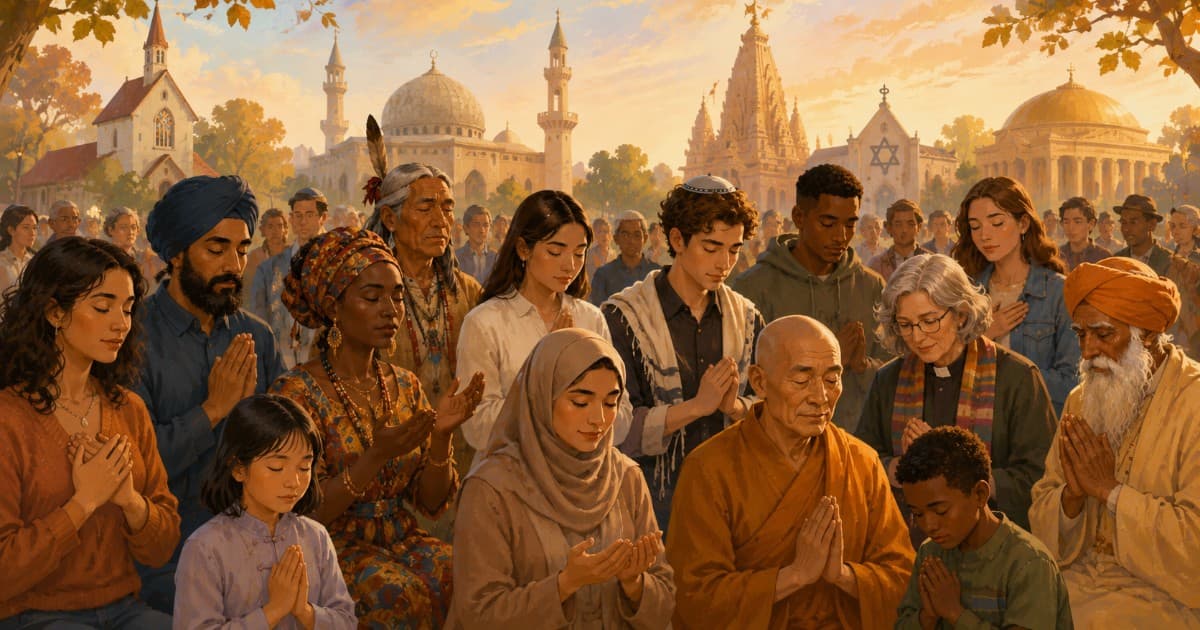
The United States is one of the most religiously diverse nations on Earth. From the Protestant settlers who shaped the early colonies to the Muslim, Hindu, and Buddhist communities that have flourished in recent decades, religion has been woven into the American story from the very beginning. Here is a closer look at the major faiths practiced across the country today — their history on American soil, and the fascinating facts behind them.
Christianity: The Foundation of American Religious Life Christianity arrived with the earliest European settlers and has remained the dominant faith ever since. Today, about 62% of U.S. adults identify as Christian, making it by far the most widely practiced religion in the country. Within Christianity, roughly 40% of Americans are Protestant, 19% are Catholic, and 3% belong to other Christian traditions. A history rooted in the colonies. When European settlers crossed the Atlantic, they brought Christianity with them — both Catholicism and Protestantism. Many came specifically seeking the freedom to practice their faith without persecution, a desire that would later shape the American principle of religious liberty enshrined in the Constitution. Protestantism became the backbone of colonial religious life, and it remains the largest Christian grouping today. It is not a single church but a broad family of traditions — including evangelical churches, mainline denominations such as Methodists and Lutherans, and the historically Black churches that played a central role in African American community life and the civil rights movement. Catholicism is the single largest individual denomination in the U.S., with about one in five Americans identifying as Catholic. Though present from colonial times, the Catholic population grew enormously during the 19th and early 20th centuries, fueled by waves of immigrants from Ireland, Italy, Poland, and later Latin America. Interesting facts:
Christianity traces its origins to the teachings of Jesus Christ in roughly 30 CE, and it is the world's largest religion. A uniquely American faith — the Church of Jesus Christ of Latter-day Saints (the Mormons) — was founded on U.S. soil in the 19th century, making it one of the few major religious movements born in America. While Christianity has slowly declined as a share of the population over the past few decades, recent data suggests that decline has leveled off since around 2019.
The "Nones": America's Religiously Unaffiliated The second-largest group in America today isn't a religion at all — it's the absence of religious affiliation. About 29% of U.S. adults are religiously unaffiliated, a group researchers often call the "nones." Of these, roughly 5% identify as atheist, 6% as agnostic, and 19% as "nothing in particular." A modern phenomenon. For decades, this group grew rapidly, especially among younger Americans. Recently, however, that growth has plateaued. Importantly, "unaffiliated" does not always mean "non-believing" — many in the "nothing in particular" category still hold spiritual beliefs; they simply don't identify with an organized religion. Judaism: A Small but Deeply Influential Community Judaism is the largest non-Christian religion in the United States, with about 2% of adults identifying as Jewish. A history as old as the nation. Jewish settlers were among the earliest non-Christian communities in America, arriving in the colonial period. The first Jewish congregation in North America was established in the 17th century, and Jewish communities have contributed to American cultural, intellectual, scientific, and political life far out of proportion to their numbers. Interesting facts:
Judaism is one of the world's oldest monotheistic religions, tracing its roots back nearly 4,000 years to the patriarch Abraham. It is the foundational faith from which both Christianity and Islam emerged — all three are known as "Abrahamic" religions.
Islam: A Growing American Faith About 1% of U.S. adults are Muslim, and it is one of the fastest-growing religions in the country. Deeper roots than many realize. While Islam's most visible growth in America came after the Immigration and Nationality Act of 1965 opened the door to immigrants from the Middle East, South Asia, and Africa, the faith's presence in America is much older. Historians estimate that a significant number of enslaved Africans brought to America were Muslim, meaning Islam has been present on American soil for centuries. Interesting facts:
Islam was founded by the Prophet Muhammad in the 7th century, and the Muslim era is dated from 622 CE, the year of his migration from Mecca to Medina. American Muslims are one of the youngest and most ethnically diverse religious communities in the country.
Buddhism and Hinduism: Eastern Faiths Take Root Both Buddhism and Hinduism are each practiced by about 1% of U.S. adults, and both have grown substantially in recent decades. Arriving from the East. The pivotal moment for both faiths was the Immigration and Nationality Act of 1965, which dramatically increased immigration from East, Southeast, and South Asia. This brought large numbers of Buddhists and Hindus to America, who established temples, meditation centers, and cultural communities across the country. Interesting facts:
The Hare Krishna movement (officially the International Society for Krishna Consciousness) was founded in the United States in 1965, introducing a branch of Hinduism to American culture. A landmark moment for religious diversity came in 1893, when the first Parliament of the World's Religions was held in Chicago, introducing many Americans to Buddhist and Hindu teachings for the first time. The event was revived in 1993 and continues today. Buddhism arose in India around the 6th century BCE from the teachings of the Buddha, while Hinduism — one of the world's oldest religions — developed in northern India over thousands of years and has no single founder. American Buddhists and Hindus tend to be significantly younger, on average, than members of most other U.S. religious groups.
How Immigration Continues to Shape American Faith Immigration remains a powerful force shaping the nation's religious landscape. A majority of U.S. immigrants — about 58% — are Christian. Around a quarter of foreign-born adults are religiously unaffiliated, while roughly 14% belong to other religions, including about 4% who are Muslim, 4% Hindu, and 3% Buddhist. Belief and Practice in Modern America Beyond labels, how do Americans actually practice their faith? Recent data shows religious practice has held fairly steady in recent years. About 44% of U.S. adults say they pray at least once a day, and roughly a third attend religious services at least once a month. Perhaps surprisingly, perceptions are shifting: between 2024 and 2025, nearly all large U.S. religious groups became more likely to say that religion is gaining influence in American life. The Bottom Line America remains a predominantly Christian nation, but one that grows more diverse with each passing generation. With deep historical roots stretching back to colonial settlers, enslaved Africans, and waves of immigrants from every corner of the globe, the United States has become a living mosaic of faith. From the oldest Abrahamic traditions to homegrown American movements and ancient Eastern philosophies, the story of religion in America is, ultimately, the story of the nation itself — diverse, evolving, and deeply human.
Sources: Pew Research Center (2023-24 Religious Landscape Study), PRRI 2025 Census of American Religion, Encyclopaedia Britannica, and historical records on religion in America.
Advertisement


Comments (0)
No comments yet. Be the first to share your thoughts.
Leave a comment
Comments are reviewed before they appear.