 World
WorldAdvertisement
World
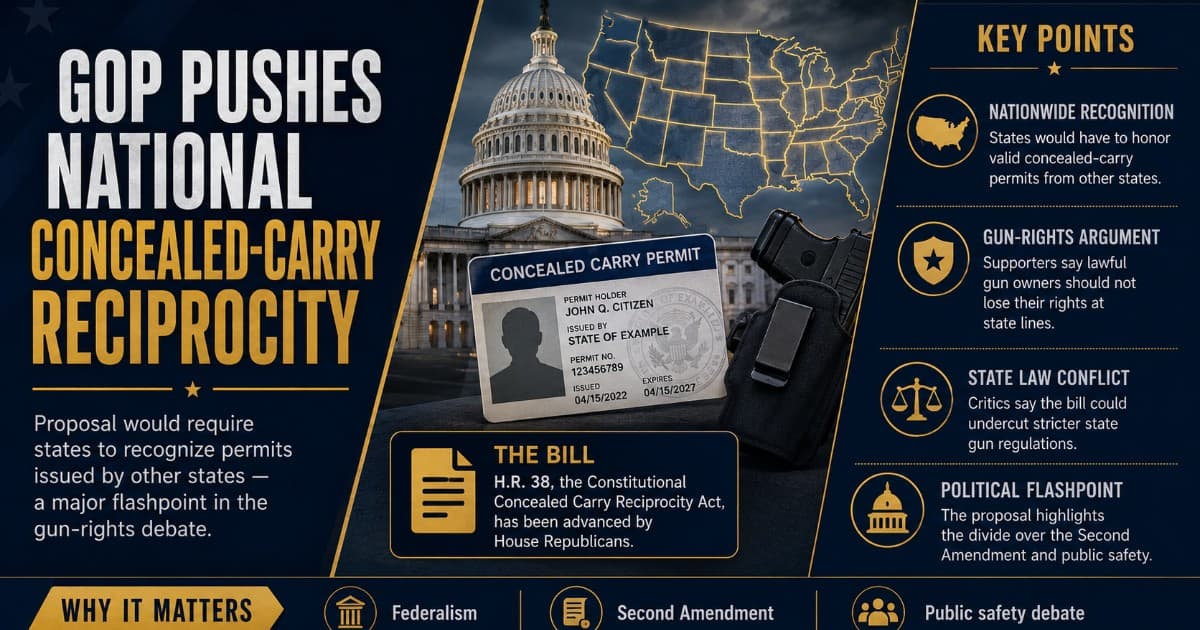
National Concealed Carry Reciprocity Bill Revived Under Trump — What It Would Mean for Gun Owners
By The Daily Ledger3 min read4 views
A renewed push for national concealed carry reciprocity would require states to honor out-of-state gun permits, sparking debate over public safety and states'…
Trump Pushes for National Concealed Carry Reciprocity
The Trump administration is backing a renewed effort to establish national concealed carry reciprocity, a policy that would require every U.S. state to recognize concealed handgun permits issued by any other state. Supporters argue the change would end a confusing and legally precarious patchwork of state laws that can turn otherwise law-abiding gun owners into criminals simply by crossing a state line.
Under the current system, whether a concealed carry permit is valid outside its home state depends on a web of bilateral agreements between states. A permit issued in, say, Texas may be honored in dozens of states but treated as meaningless — or even illegal — in states like New York, New Jersey, or California, which maintain some of the strictest permitting standards in the country.
Proponents of reciprocity often draw a parallel to driver's licenses, which are universally recognized across state lines despite varying state requirements. "If you can drive legally in one state, you can drive in all fifty," gun-rights advocates frequently argue. "The same principle should apply to the Second Amendment."
The proposal has deep roots in conservative and gun-rights circles. The House of Representatives passed a concealed carry reciprocity bill [VERIFY: confirm year and bill number — believed to be 2017] with bipartisan support, but the measure stalled in the Senate and never became law. Advocacy groups including the National Rifle Association have long listed reciprocity among their top federal legislative priorities.
Opponents of the measure, including gun-control organizations and officials from high-restriction states, warn that a federal reciprocity mandate would effectively allow the least restrictive state's standards to become the de facto national floor. A person who obtained a permit in a state with minimal training or background check requirements could legally carry in a state that demands far more of its own permit holders.
"This would completely nullify the gun laws that states like ours have spent decades building," [VERIFY: find a relevant official or organization quote to attribute, or remove if unverifiable] critics have argued.
The debate also intersects with the growing number of states that have adopted so-called "constitutional carry" laws, which allow residents to carry a concealed firearm without any permit at all. [VERIFY: current number] states now have such laws on the books, raising questions about how a reciprocity framework would treat permitless carriers seeking to travel across state lines.
The legal landscape shifted considerably following the U.S. Supreme Court's 2022 ruling in New York State Rifle & Pistol Association v. Bruen, which struck down New York's restrictive "proper cause" standard for issuing carry permits and reaffirmed a broad individual right to carry firearms in public. Reciprocity advocates argue that ruling strengthens their constitutional footing.
Whether the current push can clear Congress remains uncertain. [VERIFY: current bill name, sponsors, and Senate vote math] The Senate's procedural rules and the concerns of moderate members from competitive states have historically complicated gun legislation of any kind.
For now, millions of permit holders who travel regularly — including long-haul truckers, commuters in the mid-Atlantic region, and seasonal workers — are watching the debate closely, aware that a single wrong turn can carry serious legal consequences.
Advertisement


Comments (0)
No comments yet. Be the first to share your thoughts.
Leave a comment
Comments are reviewed before they appear.