
Advertisement
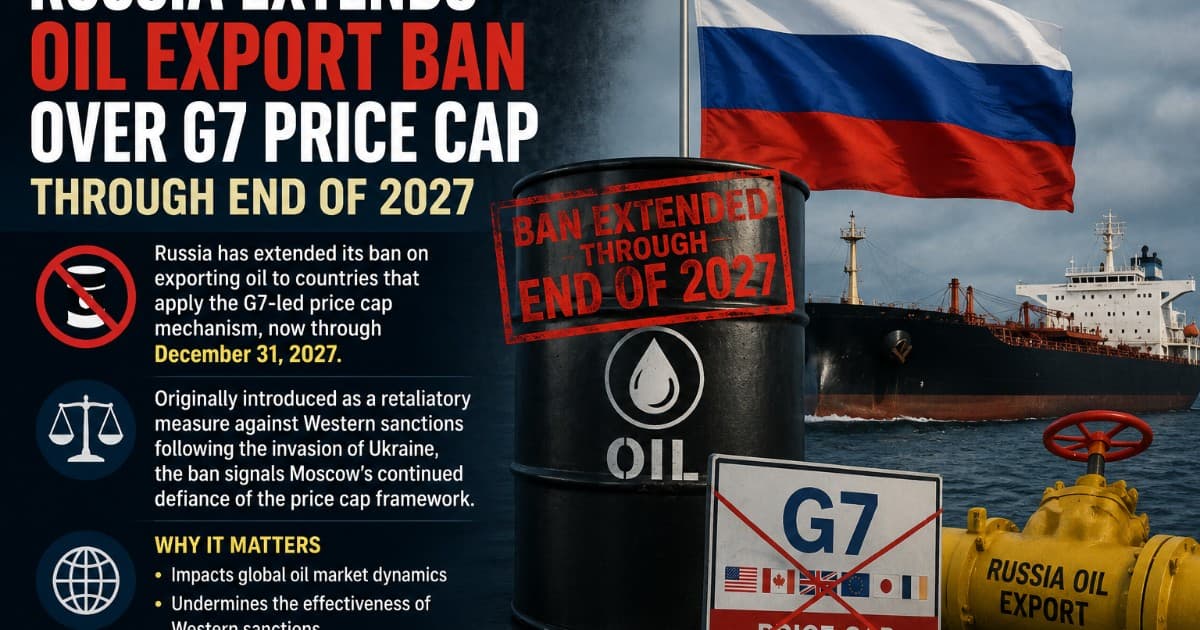
Russia Extends Oil Export Ban Against Price-Cap Nations to End of 2027
By The Daily Ledger2 min read4 views
Russia has extended its ban on oil exports to countries enforcing the G7 price cap mechanism, keeping restrictions in place through the end of 2027.
Russia Extends Ban on Oil Exports to Price-Cap Nations Through End of 2027
Russian President Vladimir Putin has signed a decree extending Russia's ban on exporting oil and petroleum products to countries that apply the Western-led price cap mechanism, keeping the restrictions in place through the end of 2027, according to reports citing the Kremlin order. [VERIFY: exact decree number, signing date, and precise effective period]
The move prolongs a retaliatory policy first introduced [VERIFY: original decree date] in response to a price ceiling imposed by the G7 nations, the European Union, and Australia on Russian seaborne crude oil. That cap, set at $60 per barrel for crude [VERIFY: whether the cap level has been revised], was designed to limit revenue flowing to Moscow to finance its military campaign in Ukraine while keeping Russian oil available to global markets at a controlled price.
By extending the ban for roughly another two years, the Kremlin is signaling that it regards the confrontation over oil pricing as a prolonged standoff rather than a temporary dispute. Russian officials have consistently described the price cap as an illegal interference in global commodity trade.
In practical terms, the ban's direct impact on day-to-day Russian oil flows has been limited, largely because Russia's biggest customers — China and India — have continued purchasing Russian crude through arrangements that fall outside Western financial and shipping systems. Both countries have declined to participate in the price cap framework. [VERIFY: current share of Russian oil exports going to China and India]
Nevertheless, the extension carries symbolic and strategic weight. It cements Russia's deliberate decoupling from Western energy markets and reinforces its reliance on a parallel trading infrastructure, sometimes referred to as the "shadow fleet" of tankers operating beyond Western insurance and regulatory oversight. [VERIFY: latest estimates of shadow fleet size]
The price cap's effectiveness has been contested since its introduction. Russian crude has at various points traded both below and above the $60 threshold depending on the grade, route, and buyer, raising questions about enforcement. Western officials have periodically debated whether to lower the cap or introduce stricter secondary sanctions to close loopholes. [VERIFY: any recent G7 statements or proposals on cap adjustment]
The extension through 2027 aligns the ban well beyond the next scheduled reviews of the price cap framework, suggesting Moscow is prepared to maintain its current stance regardless of how Western policy evolves in the near term.
Energy analysts will be watching whether the decree prompts any formal response from G7 finance ministers or the European Commission, and whether it accelerates Russia's push to settle oil transactions in non-dollar currencies with alternative buyers. [VERIFY: any immediate market or diplomatic reaction following the announcement]
Advertisement


Comments (0)
No comments yet. Be the first to share your thoughts.
Leave a comment
Comments are reviewed before they appear.